Kung Fu Scrolls
What UNESCO’s Taijiquan Listing Actually Says
Read UNESCO’s 2020 Taijiquan decision, China’s nomination file, and the older records you would need to check a claim about tai chi history.
Direct answer
In 2020, UNESCO’s Intergovernmental Committee added Taijiquan, also called tai chi, to the Representative List of the Intangible Cultural Heritage of Humanity. China submitted nomination file 00424. The year records the inscription. To check a claim about when the practice began, look for evidence from or about the period the claim describes.
Key takeaways
- Save the decision number for a claim about the inscription.
- Record the issuer and section when you cite a nomination.
- For an older claim, write down both the date of the source you read and the date of the event it describes.
Find the decision number
If a caption says Taijiquan was listed in 2020, look for decision 15.COM 8.b.21. You can use that number to find the Committee’s record. Article 16 of the 2003 Convention explains the purpose of the Representative List. It gives living heritage greater visibility and encourages dialogue about cultural diversity.
Sources: UNESCO Committee decision 15.COM 8.b.21; UNESCO 2003 Convention, Article 16
Read the nomination as a submission
When a paragraph describes how Taijiquan is taught or passed down, check who supplied the account. China’s English nomination form describes how communities helped prepare the application in section 4.a and documents consent in 4.b. Section 5 identifies the national inventory and gives dates for inclusion. If you cite one of these details, put the file number and section in your note so the next reader can find it.
Track two dates when reading a historical claim
For a claim about an earlier teacher, place or form, begin with the oldest source the writer cites. Record the date of the copy or edition you can inspect and the date of the event it describes. Check which name the source actually uses for the practice. Douglas Wile’s study of new Taijiquan document finds discusses the provenance and disputed authenticity of manuals, genealogies and stone inscription rubbings. It gives you examples of questions to ask about a record before using it to fix a date.
Keep a note you can check later
Take one sentence you want to share and put it next to the record that supports it. Include an identifier where you can, such as a decision number, a nomination section or the page of an edition. For a story described as a legend, record who tells it and retain that description.
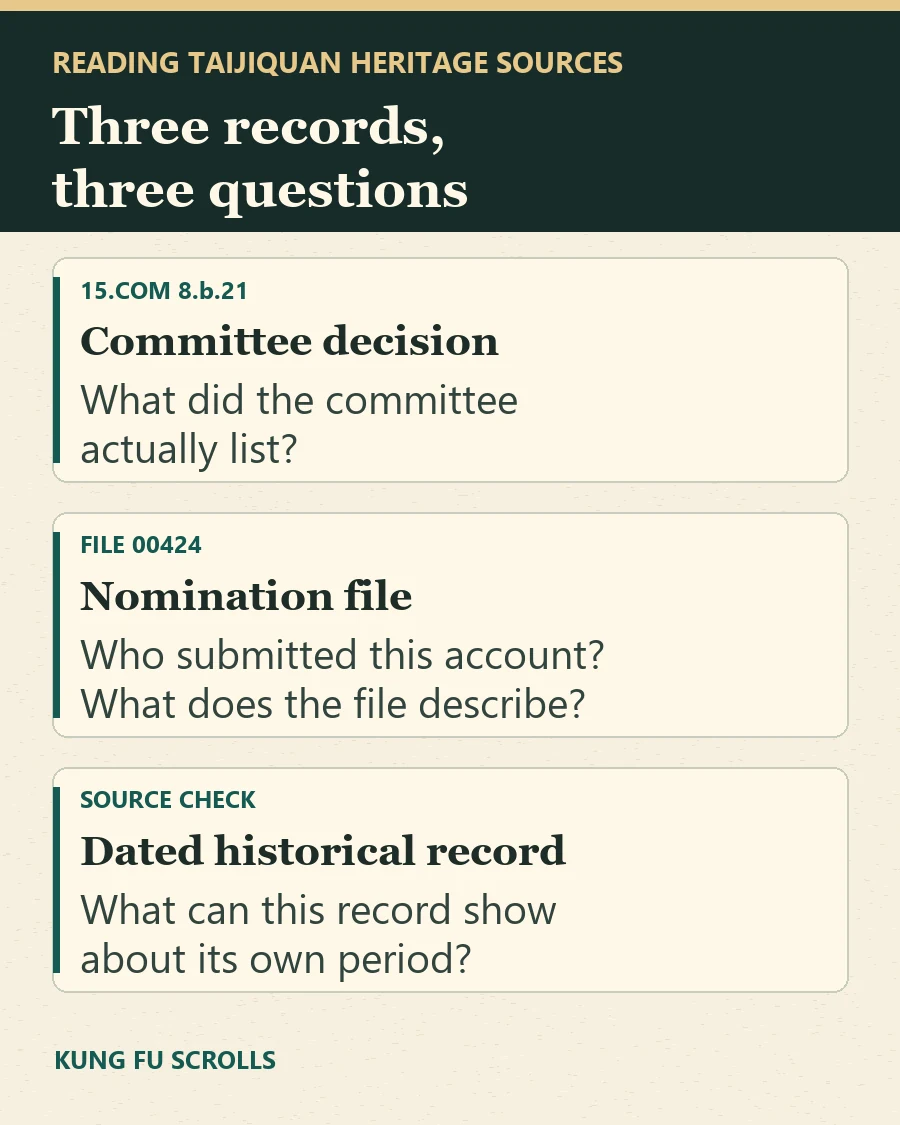
- Committee decision
Taijiquan was added to the Representative List in 2020. Look up 15.COM 8.b.21.
- Nomination file
China’s submission describes community participation in section 4.a. Look up file 00424.
- Dated historical source
Write down the date of the record, the date of the event it describes, and the words it uses for the practice.