Kung Fu Scrolls
Hong Kong Martial Arts Films: What to Watch After Bruce Lee
Choose your next Hong Kong martial arts film from four starting points, then use a viewing notebook to separate screen action, interpretation and history.
Direct answer
Start with Drunken Master for Jackie Chan’s action comedy, Zu: Warriors from the Magic Mountain for fantasy, Ip Man for a dramatized life, or Painted Faces for the work behind performance. Pick the kind of film you want to watch tonight. Afterwards, write down one thing you saw, your reading of it, and one question you could check elsewhere.
Key takeaways
- For comedy, watch how the choreography sets up a joke.
- For a film about a real person, describe what the character does before asking what the historical record supports.
Four films, four ways in
The Hong Kong Film Archive’s 2024 Of Fists and Swords programme grouped films by themes such as comic remixes, reimagined lives and work behind the scenes. These four choices borrow that curatorial approach. The screening pages document a past programme. Check lawful availability and the edition in your region.
- Comedy · Drunken Master (1978)
The archive describes Jackie Chan’s training scene with tiny cups and a bucket. Watch how the task gets harder before the joke lands. Notice when the film lets you see the setup and when it cuts to the result.
- Fantasy · Zu: Warriors from the Magic Mountain (1983)
The archive describes the optical effects used to create the purple and green swords in Tsui Hark’s film. Watch for the moment the swords show you what can happen in this imagined world.
Sources: Hong Kong Film Archive on Zu
- A dramatized life · Ip Man (2008)
The story draws on the life of a Wing Chun master. When you come across a scene you want to repeat as a historical anecdote, write down precisely which event needs a source first.
Sources: Hong Kong Film Archive programme announcement; Hong Kong Film Archive on Ip Man
- Performance · Painted Faces (1988)
Alex Law’s film adapts the story of Peking opera teacher Yu Zhanyuan, played by Sammo Hung. Watch for the rehearsal and training work the film brings into view before a performer reaches the stage.
Try the notebook on one Ip Man scene
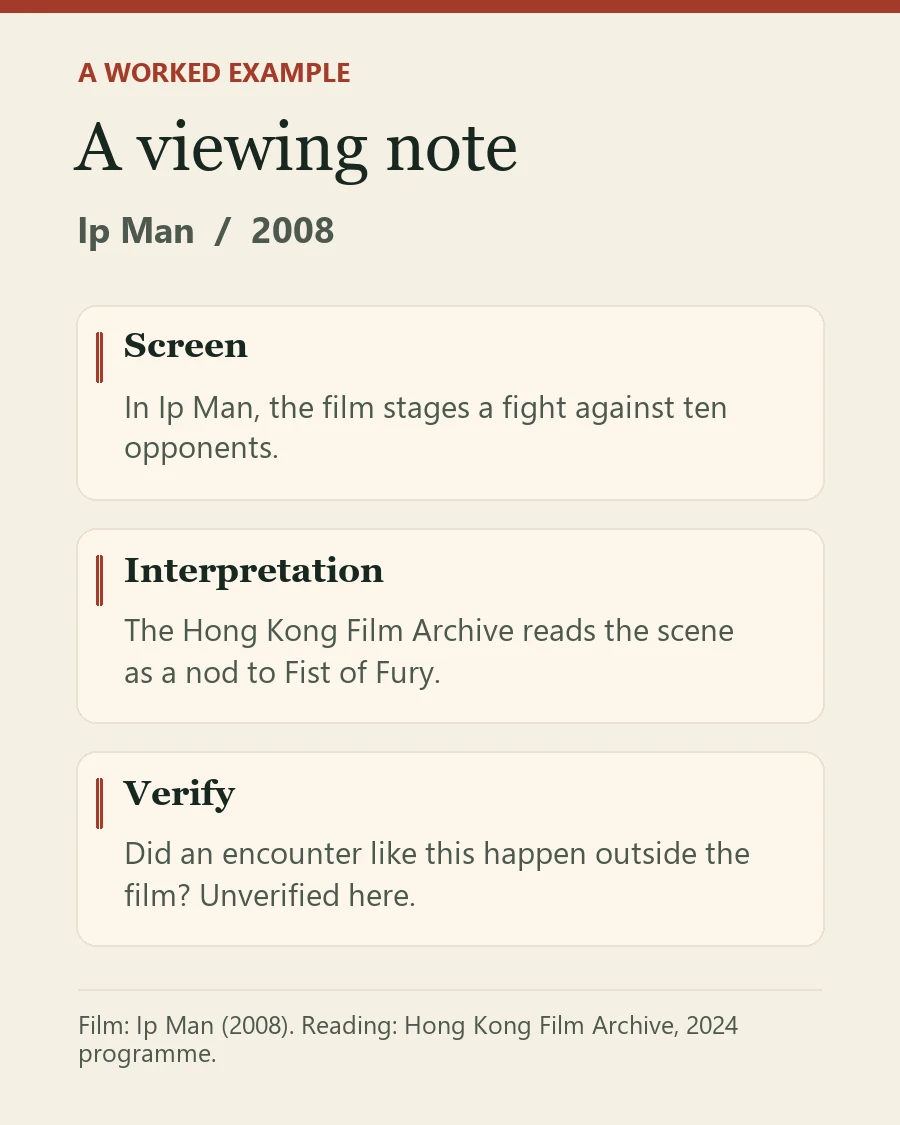
The programme note describes a prison fight in which Ip takes on ten opponents. It reads the scene as a tribute to the Bruce Lee film Fist of Fury. Write your notes while the shot, cut or sound you remember is still fresh.
- Screen
In the film, Ip fights ten opponents in a military prison.
- Interpretation
The archive reads the scene as a nod to Fist of Fury. My own note might ask what the reference does for a viewer who knows the earlier film.
- Verify
Did a comparable fight happen outside the film? A dated record or historical study would need to support that specific encounter. It remains unverified here.
Sources: Hong Kong Film Archive on Ip Man
Carry one question into the next film
If you liked the comic timing, look for another credit by a performer or choreographer you noticed. If you kept pausing to ask what really happened, choose one precise claim and take it to a dated source. When a story survives as a legend, name the person or publication that tells that version and keep the attribution with the story. For a discussion with friends, bring one scene and one question. A film can give you plenty to describe before you settle what it means.
Can I learn the movements from a film?
Use screen action to study framing, rhythm and performance. Stunts and fights are staged for the camera. If your interest turns to practising movement, our reading guide on visual study and live instruction explains where feedback matters.